








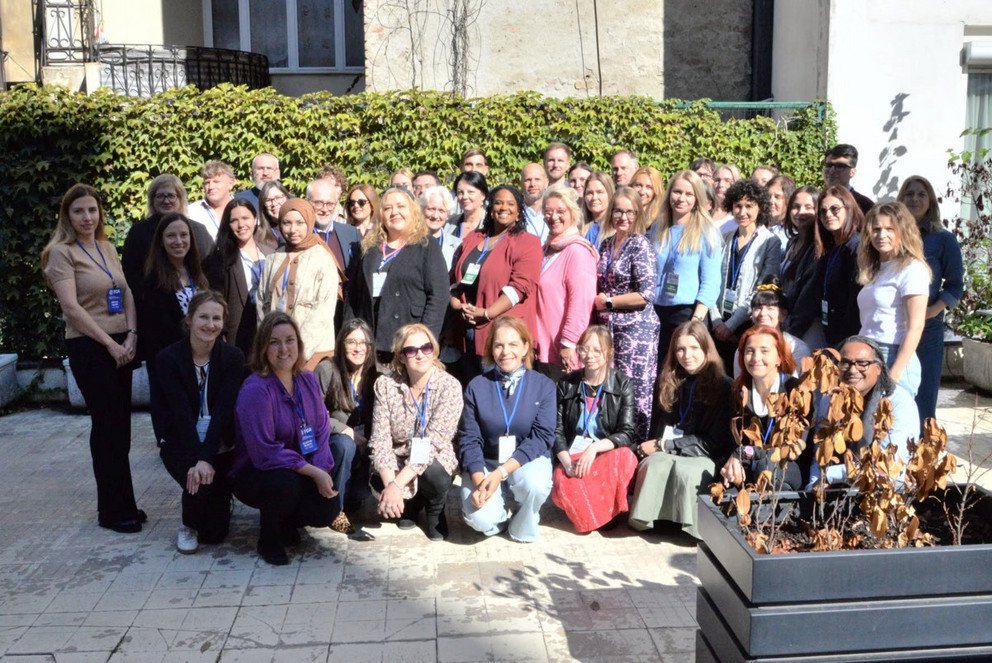
Students and staff bring a wide range of languages, cultural experiences and educational backgrounds to university life. How can this diversity be made more visible and used as a resource for learning? These questions were at the heart of the Erasmus+ Training and Cooperation Activity (TCA), “Multilingual and Multicultural Classrooms – A Resource, Not an Obstacle”, held in Belgrade on 13–14 October 2026.
Sabine Ophelia Blake, Senior Lecturer in English at the University of Passau's Language Centre, attended the event at the invitation of the German Academic Exchange Service's National Agency for Erasmus+ Higher Education Cooperation (NA DAAD). She was one of 40 participants from 15 countries who came together to exchange ideas on multilingualism, intercultural education and approaches to inclusive teaching and learning.
Multilingualism as a Foundation for Democratic Education
One of the key contributions came from Professor Terry Lamb of the University of Westminster. In his presentation, “Valuing Plurilingualism and Using It as a Resource in the Classroom and Beyond”, he highlighted the importance of linguistic diversity for education and society. Engaging with different linguistic and cultural perspectives enables people to better understand other viewpoints and participate more thoughtfully in collective decision-making.
The Council of Europe also emphasises this connection. Its Recommendation CM/Rec(2022)1 highlights the role of plurilingual and intercultural education in developing a culture of democracy. At its heart lies a fundamental principle: language education is also democracy education.
Multilingualism, however, does not necessarily mean being highly proficient in as many languages as possible. The concept of plurilingualism refers instead to an individual's entire linguistic repertoire. This includes different languages and language varieties, partial competences, personal experiences and different ways of using language. What matters is recognising, valuing and incorporating these abilities into the learning process.
The broader significance of language education is also reflected in the current programme of the European Centre for Modern Languages (ECML), an institution of the Council of Europe. Entitled “Language Education at the Heart of Democracy”, the programme for 2024–2027 places the role of languages in democratic life and social participation at its centre.
Making Linguistic Diversity Visible on Campus
An example from the University of Westminster illustrated how universities can better identify and draw upon their linguistic diversity. A university-wide survey was conducted to gain a clearer understanding of the linguistic repertoires of students and staff. In 2024, 627 respondents reported a total of 133 languages and 61 language varieties.
The findings revealed the extent of linguistic diversity already present in everyday university life, much of which had previously gone largely unrecognised. They also provided a basis for initiatives aimed at raising the visibility of multilingualism on campus and informing the development of an institutional language policy.
The University of Passau is similarly committed to recognising and promoting linguistic diversity throughout university life. Its approach goes beyond potential measures such as a voluntary language survey and includes ongoing work on the development of an institutional language policy.
“The University of Passau is currently developing a language policy that reflects the linguistic diversity of the university community and places a clear emphasis on multilingualism. At a time of increasing internationalisation, the University of Passau is committed to valuing the languages spoken by its students and staff and making them more visible.” — Dr Michael de Jong, Managing Director of the University of Passau's Language Centre
With its Diversity Guidelines and Teaching Strategy, the University of Passau already has important foundations in place for promoting linguistic diversity as an integral part of an inclusive university culture. The ongoing development of a language policy builds on these foundations, placing multilingualism at the centre as a valuable resource for the university community as a whole.
Insights for Language Teaching and Teacher Education
Alongside discussions of education policy, the event in Belgrade offered numerous opportunities to explore how multilingual education can be put into practice. In workshops on Content and Language Integrated Learning (CLIL) and plurilingual learning, participants explored and discussed methods for integrating subject content with language learning.
Such approaches are particularly relevant to teacher education. School classrooms bring together children and young people with diverse linguistic backgrounds. When pupils' home languages are actively incorporated into teaching, they can draw more effectively on their existing knowledge and participate more fully in classroom activities.
These principles are equally relevant to university teaching. Comparing languages, designing multilingual tasks and exploring different cultural perspectives together all offer opportunities to make linguistic diversity a meaningful resource for learning. Participants do not need to speak the same languages. Rather, the aim is to recognise different linguistic abilities as an enrichment of the shared learning experience, rather than as a barrier.
Through its wide range of language courses and international teaching projects, the University of Passau's Language Centre already provides numerous opportunities for linguistic and intercultural learning.
One example is Global.Classrooms, a project that connects students across national borders and encourages them to communicate with one another. Such initiatives create opportunities for authentic language use while fostering an exchange of experiences and perspectives.
Within the French Language Section, the service-learning project “Vision Dindefelo – Practical Course Senegal” combines the practical application of French language skills with intercultural collaboration and social engagement. As part of a German-Senegalese university scholarship programme, students from Passau support project activities and engage with partners in Senegal.
The Italian Language Section's “In Medias Tres” project gives advanced students the opportunity to research current topics relating to Italy, conduct interviews and produce their own video reports in Italian. The project combines language practice, media literacy and intercultural learning through authentic, project-based activities.
There are close pedagogical connections between CLIL and action-oriented, communicative foreign language teaching. After all, languages cannot be taught effectively in isolation from meaningful content. Language learning becomes engaging and sustainable when learners explore relevant topics and apply their linguistic skills in authentic communicative situations. In this sense, all effective foreign language teaching incorporates elements of the CLIL approach.
Dr Michael de Jong also emphasises the importance of this practical, content-based approach: “The University of Passau's Language Centre consistently implements an action-oriented, communicative approach to foreign language teaching and is one of the largest and most innovative institutions of its kind in Germany. It is through the practical application of what has been learnt that the continuing importance and considerable added value of learning foreign languages become clear, even in the age of artificial intelligence.”
Language Education as a Responsibility to Society
The international exchange in Belgrade highlighted, from a European perspective, that multilingualism should not be viewed solely in terms of professional qualifications or international mobility. Language education also develops the ability to understand different perspectives, engage in constructive dialogue and participate actively in society.
For the University of Passau, the insights gained in Belgrade provide valuable inspiration for further developing a language-aware and inclusive university culture that recognises linguistic diversity as both an opportunity and a resource.
A multilingual campus is more than a reflection of internationalisation in practice. Making its linguistic diversity visible, valuing it and actively promoting it are integral to the university's educational mission – and represent a long-term investment in educational equity, social participation and democratic culture.